

PFAS (per- and polyfluoroalkyl substances), also known as “forever chemicals,” are widely used in textiles due to their water repellent and stain resistant properties.
With the tightening of environmental regulations and the progressive ban on the manufacturing, import, and export of PFAS‑containing textiles, companies must now ensure the compliance of their products to remain competitive in the market.
Why Test PFAS in Textiles?
Regulations are evolving rapidly, and PFAS are now among the most closely monitored substances in the textile industry.
Conducting reliable analyses allows manufacturers to:
- Ensure compliance with new legal requirements
- Reduce risks associated with Restricted Substances Lists (RSL)
- Meet growing consumer expectations regarding eco‑responsibility
- Protect brand reputation and reduce the likelihood of product recalls
- Support the development of future‑proof, regulation‑compliant products
Advanced Analytical Methods: HPLC‑MS/MS for Maximum Precision
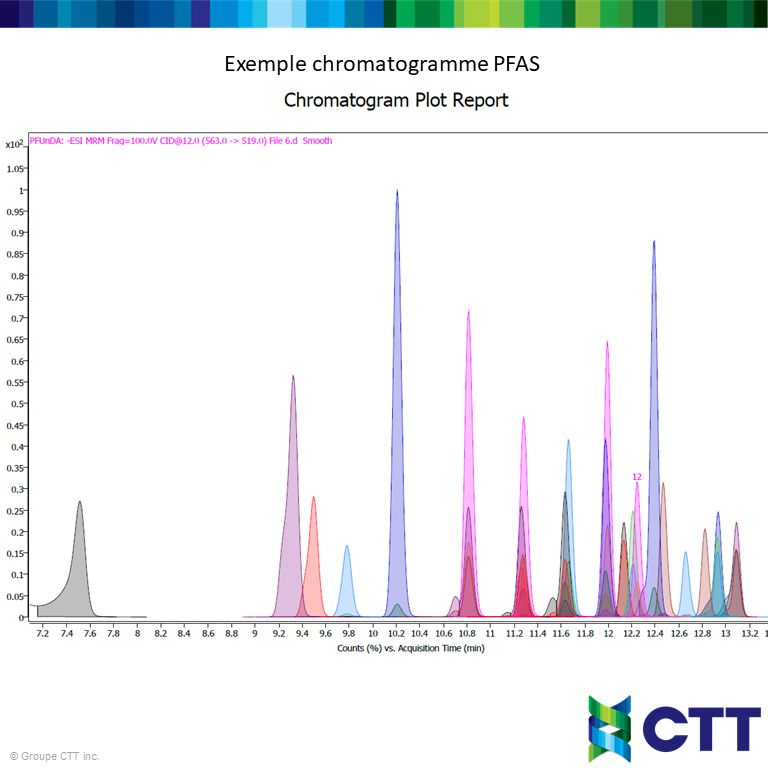
PFAS testing requires high‑performance technologies. Using HPLC‑MS/MS, it is possible to detect and quantify PFAS at extremely low concentrations.
Groupe CTT has developed analytical methods aligned with international standards, offering:
- Detection limits below 1 ppb
- Accurate identification of multiple PFAS in textile materials
- Reliable results to support your regulatory compliance efforts
A Service Tailored to the Textile Industry
Our methods are designed to support manufacturers, importers, distributors, and brands seeking to ensure that their textile products meet current PFAS‑related regulations.
List of measured PFAS
| C9-C14 PFCA-related substances | ||
| Abb. | CAS No | Name |
| PFOS | 1763-23-1 | Perfluorooctanesulfonique acid |
| PFOSA | 754-91-6 | Perfluorooctanesulfonamide |
| N-Me-FOSA | 3506-32-8 | N-Méthylperfluorooctanesulfonamide |
| N-Et-FOSA | 4151-50-2 | N-éthylperfluorooctanesulfonamide |
| N-Me-FOSE | 24448-09-7 | N-Méthylperfluorooctanesulfonamidoéthanol |
| N-Et-FOSE | 1691-99-2 | N-éthylperfluorooctanesulfonamidoéthanol |
| PFHpA | 375-85-9 | Perfluoroheptanoïque acid |
| PFOA | 335-67-1 | Perfluorooctanoïque acid |
| PFNA | 375-95-1 | Perfluorononanoïque acid |
| PFDA | 335-76-2 | Perfluorodécanoïque acid |
| PFUdA | 2058-94-8 | Perfluoroundécanoïque acid |
| PFDoA | 307-55-1 | Perfluorododécanoïque acid |
| PFTrDA | 72629-94-8 | Perfluorotridécanoïque acid |
| PFTeDA | 376-06-7 | Perfluorotétradécanoïque acid |
| Further perfluorinated carboxylic acids | ||
| PFBA | 375-22-4 | perfluorobutanoïque acid |
| PFPeA | 2706-90-3 | perfluoropentanoïque acid |
| PFHxA | 307-24-4 | perfluorohexanoïque acid |
| PF-3,7-DMOA | 172155-07-6 | perfluoro-3,7-diméthyloctanoïque acid |
| Perfluorinated carboxylic and sulfonic acids | ||
| PFBS | 375-73-5 | perfluorobutanesulfonique acid |
| PFHxS | 355-46-4 | perfluorohexanesulfonique acid |
| PFHpS | 375-92-8 | perfluoroheptanesulfonique acid |
| PFDS | 335-77-3 | perfluorodécanesulfonique acid |
| Partially carboxylic and sulfonic acids | ||
| 7HPFHpA | 1546-95-8 | 7H-perfluoroheptanoïque acid |
| 4HPFUnA | 34598-33-9 | 4H-perfluoroundécanoïque acid |
| 6:2 FTS | 27619-97-2 | 6:2 fluorotélomèresulfonique acid |
| PFOA-related substances | ||
| 8:2 FTS | 39108-34-4 | 8:2 fluorotélomèresulfonique acid |
Always going further to support you!
New molecules are regularly added to our analyses to meet the growing needs of the textile industry.
Our detection technologies perfectly complement ongoing innovation efforts:
- fluorine‑free water‑repellent formulations,
- evaluation of recycled materials,
- characterization of post‑industrial and post‑consumer textile streams.
More info: info@gcttg.com


Ce projet de recherche et développement visant l’innovation dans le domaine des matériaux avancés a été rendu possible grâce au soutien financier du Ministère de l’Économie, de l’Innovation et de l’Énergie (MEIE), par l’intermédiaire de PRIMA Québec et TechniTextile Québec, dans le cadre de l’Appel à projets d’innovation collaborative pour les secteurs d’activités des créneaux d’excellence, en collaboration avec plusieurs partenaires industriels ».